My Ramadan Reflections
In my twenty five years as a Muslim woman, I have only properly fasted twice. The first was in 2024, when I returned to Malaysia after being in Europe for five years. The second is this year, 2026.
To me, properly fasting meant waking up before dawn for sahur, avoiding food and drink throughout the day, and then breaking my fast at maghrib for as many days as I could during Ramadan. Anything outside these parameters, done on the majority of days in Ramadan, would nullify my fast.
My family was never really strict. My parents didn’t really take Ramadan seriously, and they never pressured me to fast. Similarly, back in elementary school, when I was living with my grandparents, my grandmother would wake me up for sahur, mainly because my grandfather observed Ramadan and she wanted to avoid any unnecessary comments from him if us grandkids didn’t partake in the holy month’s requirements.
For sahur, my grandmother always prepared some rice, a protein dish, and a fibre dish. I remember hating the fact that I had to wake up that early just to eat. But, as I got ready for school, picked up my bag, and was about to head out the door, my grandmother would call me into the kitchen. She’d hand me two pieces of Gardenia bread in a ziplock bag, each folded with a slice of cheese in between.
She’s tell me “if you get hungry around lunch time, head over to the girls room and eat this sandwich. Just don’t tell anyone.” A small nod of approval and a cheeky smirk, and she’s send be towards the gate just before the school bus arrives outside.
The routine remained very much the same, even after she passed away. Except this time, I never had to fear about my grandfather finding out since I had moved out of the house and I think he just assumed that I celebrate Ramadan every year.
But all of that changed in 2024, just after I departed Europe to return to my hometown of Kuala Lumpur. As Ramadan was approaching that year, I made the conscious decision to fast. There were a few reasons as to why.
The first was I wanted to simply understand what all the fuss was about. Everyone seemed to halt their work by 4:30 p.m, rushing to get to the bazaar lines in hopes of getting a decent piece of Murtabak or Ayam Percik wings. The nights belonged to Terawih prayers and Moreh get-togethers. Both men and women suddenly donning Abayas. All this shift in behaviours intrigued me. The only way to fully understand something, is to immerse yourself in it.
A more depth analysis would be that all those years abroad has left me feeling disconnected to my culture, my religion and my people. A part of me always wanted to feel like I belonged somewhere, particularly in Malaysia. Taking part in Ramadan seemed like an easy away for me to slowly rekindle my relationship with the Malay, Muslim, Malaysian identity. Especially, now that I am a young adult who is trying to form her long term identity and who’d lost parts of herself during her years outside of Asia.
The second was I simply just had a change of heart. Something within me just said “You can do it. Just fast.” That is the straightforward answer. If my 86 year old grandad can do it, so can I.
As I am nearing the end of what I would consider to be a successful sophomore season of Ramadan, I decided to share the reflections I have made this past four weeks. These are observations of myself, people around me or the general atmosphere in Kuala Lumpur in this time.
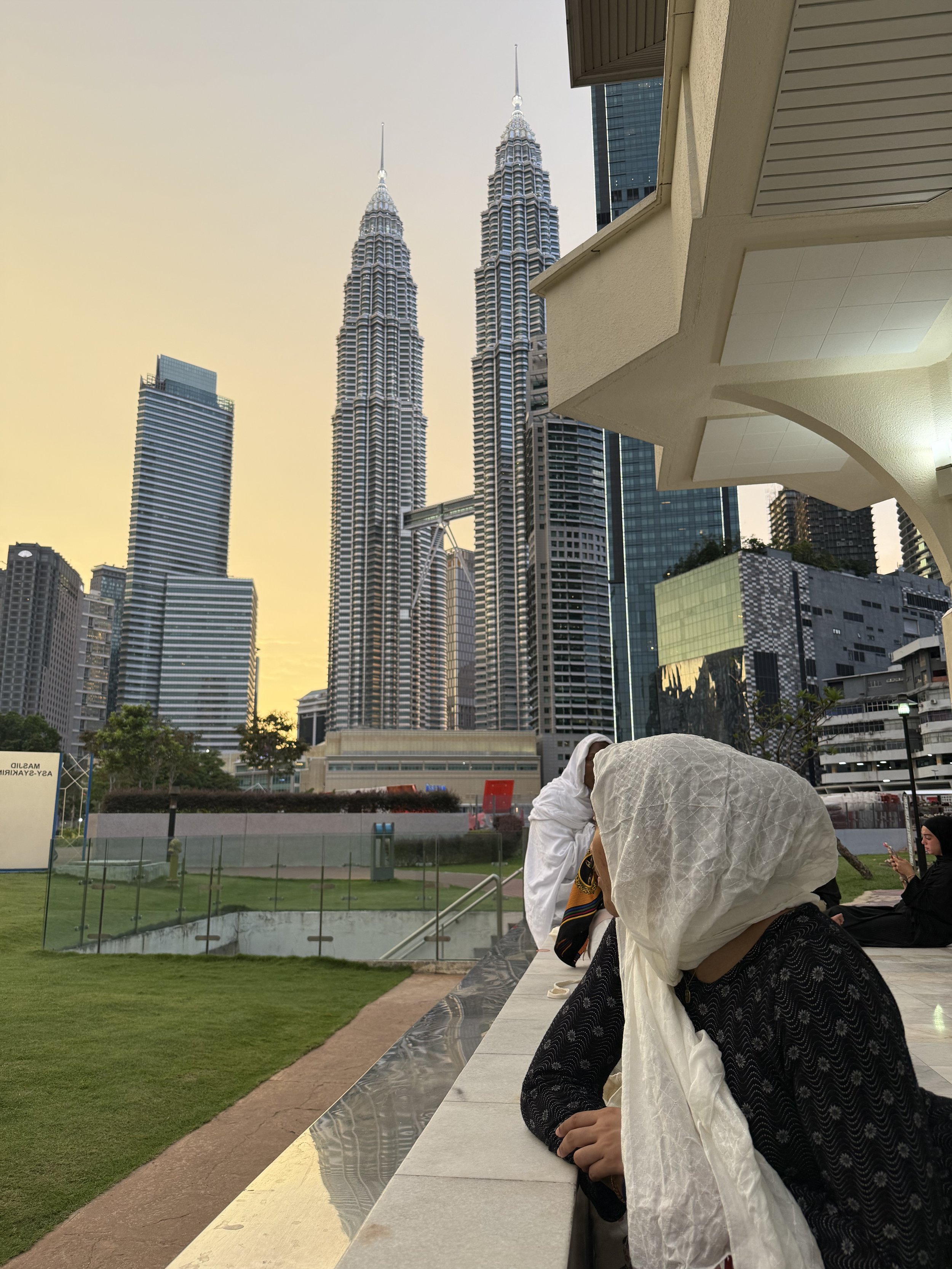
It is easier to fast when you are in colder spaces or during working hours. I find myself with the worse migraines one could possible imagine when I am in warmer spaces such as my house. I am not the biggest fan of air conditioning, preferring to just turn on the ceiling fan. So you can imagine how much I perspire just sitting down on the couch in my living room. When I am in my office which feels like Sweden or Finland in late November almost everyday, I never get any sort of headache. With that said, when you are working, you are just distracted with your BAUs and To-Dos. I am distracted from the fact that I am fasting or the better word would be focused on the things I need to get done because now my working hours feel shorter. I just completely forget about my lunch, the 4 litres of water I usually drink and even the fact that I sometimes peel my nails when they are too long.
Speaking of food and water, the hardest part isn’t even the food or the lack of water you are consuming — of which the latter is always much more thought of anyway — but rather all the other small intricacies that would invalidate your fast. No swearing, no picking your nose, no impure thoughts. Those are a bit more challenging because sometimes it comes naturally. A man cut me off and entered the LRT even though I was in front of the line. All I have to tell myself is to stay calm instead, of swearing.
When it comes to breaking my fast, I realise that I can’t even eat that much for Iftar. My go to Iftar meal is a smoothie: two bananas, 4 dates, dark cocoa powder, flax seeds and low fat milk. Anything more at that very hour would be a shock to my body, which has been in calm state for more than 12 hours. So any of that spicy sambal food or goreng-goreng seems to not sit well with me. Though as I am stubborn person, I will still go for my favourite Nasi Kerabu with extra sambal.
Anyways, Iftar food should be humble. Growing up, I was taught that one of the main points of Ramadan is to experience what those that are less fortunate experience on a daily basis: teaching us to be more grateful and appreciative of what we have as well as sympathetic of those that are not so privilege. So, I actually fail to understand how so many people can spend RM 200++ for a Ramadan buffet at a five star hotel. Seriously, can you all even consume the entirety of the buffet? Plus, I don’t think the less fortunate goes to eat a buffet, after unable to get decent food or drinks through the whole day. Yes, you will see me at a company Iftar buffer but you will never find me at a buffet in which I have to pay because I also hate the amount of food waste that goes on during these festivities.
This keeps me up at night sometimes, the amount of food that is wasted and what happens to it. Speaking of, as someone who takes care of her daily routine, I had to say goodbye to any decent sleeping schedule I had. Somehow the window of time at night becomes so narrow and you feel like you need to squeeze everything in those hours: Iftar, terawih with family, moreh with friends, your 10k steps or a 5k run, time to write this piece, read a book, personal time with god, and the list goes on. All the sudden, its 2 a.m. and you are about to get less than 4 hours of sleep before waking up to do the whole thing over again, starting with sahur which becomes earlier as the days progress.
Despite the lack of sleep, my workout specifically gym routine has been better. I actually feel stronger when I am lifting weights because I am doing less exercises, maintaining similar or slight heavier weights with lesser reps. All this combined with the lesser calories consumed due to a shorter eating window, naturally makes weight loss easier. Again, all plausible because I avoided the buffets and stayed consistent in my regime. Though I would recommend to reduce number of days you are hitting those weights, I went from a 5 day split to a 3 day split combined with evening runs. Just something that worked out for me but of course everyone has their own goal and approach to follow.
All of the changes in daily habits are not just noticeable by me. At our Iftar dinners or late night moreh catch ups, my friends seem to acknowledge the shift as well. And these get togethers itself is a wholesome trait of Ramadan: the unspoken rule where everyone starts to reconnect with those they have not seen in a while. Cafes opening until 3 am to accommodate families wanting a change of scenery and youngsters wanting a cool place to lepak. Community events become more prominent in the effort to allow friends, families, neighbours to meet in a casual way. This very act of meeting up again with everyone — in which the invite is rarely turned down — brings me some sort of peace and positively to the whole environment. For a lack of better word, it just feels wholesome.
This is perhaps attributed to the idea that everyone is nice and seem to be on their best behaviour during the month. Don’t get me wrong, I’m sure people are sweet but I feel like there is an additional layer of concious effort to portray favourable traits. I keep seeing all these memes and TikToks of Muslim boyfriends disappearing for 30 days and then coming back to look for their girlfriends after Eid. From what I see from my friends, it is somewhat true. Everyone takes a pause on their vices for the month. Those that like to gamble, find themselves at the mosque for prayers instead of the poker table. Those who spend their Wednesday nights at a bar, are meal prepping for Sahur in the kitchen. Those who spend their Friday evenings on escapades with their lovers, stay in and read the Quran till dawn. It all feels like someone dramatically pressed the brake pedals on their general sins for this one month. No gambling, no sex, no alcohol, no anything of that sort: for one month.
In the end, these observations make me fall in love with Ramadan even more. All the changes in habits and rituals challenge us and to me, that makes us feel more alive. To feel uncomfortable, to alter routines and meet the demands of a higher power. It leaves me with a calming and easy sensation which is unexplainable. I am fascinated at myself, for managing to embed Ramadan’s alteration of my life for a mere 30 days. For those who are like me, starting fast at this age, past your youth — you can do it. I took it as a way for god and the universe giving me a chance to have a brief shift and reset into my thoughts, actions and relationships with everything around me.
- T
